A colleague talks over everyone, a cousin reads hostility into a one-word reply, a manager treats every decision as a contest. Researchers who studied antagonism reduced that mess to seven traits of a difficult person, and naming the one in front of you tells you what to do next.
The seven come from published research on antagonism, summarised in this Psychology Today article, and they are the traits the difficult person test on this site scores. I take them one at a time below, with what each looks like in a meeting, a group chat and a kitchen. More important, I separate each from its healthy cousin, because every one of these traits has a version that is a strength.
This is a self-reflection read, not a diagnosis or a psychological assessment. Nothing here labels a person; it describes behaviour you can observe.
Where the seven traits come from
The traits come from Sleep, Crowe, Carter, Lynam and Miller, "Uncovering the structure of antagonism", published in Personality Disorders: Theory, Research, and Treatment, work from the University of Georgia group. They had 532 college participants (57% female, average age 19) complete seven established personality measures, then used a stepwise factor analysis to see how the measures split into narrower traits. Keep the sample in mind: students, so the pattern may not carry over unchanged to older people or to other groups.
Antagonism is the low end of agreeableness in the Big Five model of personality. In the study it was linked with criminal behaviour, aggressiveness and substance use. That describes patterns across many people in a data set. It does not describe the coworker who interrupts you, and I would never use it that way. Joshua Miller, one of the researchers, has stressed context: behaviour that causes trouble in one setting can be fine in another, a flexible personality is a healthy one, and only difficulty that persists across all settings points toward something a professional should look at.
The seven traits at a glance
| Trait | Definition in the study summary | Healthy cousin |
|---|---|---|
| Callousness | Lacking empathy or concern for others | Staying steady in a crisis, then checking in afterwards |
| Grandiosity | Feeling better than other people | Confidence that rests on actual results |
| Aggressiveness | Being hostile and rude toward others | Assertiveness: firm, direct, still respectful |
| Suspiciousness | Strong and unreasonable distrust of others | Caution that updates when evidence arrives |
| Manipulativeness | Exploiting others to benefit oneself | Persuading in the open, and accepting a no |
| Dominance | Desire for authority over others, plus combativeness | Taking charge when a group needs it, then handing it back |
| Risk-taking | Looking for thrills through risky behaviour | Adventure with a safety margin |
Each trait at work, at home and online
Callousness
At work it sounds like a teammate saying they are drowning and getting "OK, so who takes the report?" in reply. At home it is a list of reasons why your bad day is inconvenient. Online it is a joke or a change of subject under someone's bad news. One cold moment proves nothing, since anybody has a bad day. The tell is a pattern of not registering how other people are doing at all.
Healthy cousin: calm under pressure. A steady person in a crisis still asks "are you OK?" once it is over. Self-check: when did I last change a plan because someone else was struggling?
Grandiosity
In a meeting it is the person who corrects everyone, says "I" about group results and treats deadlines as something for other people. At home it is the best seat and the last word. Online it is a reply under every thread explaining how they would have done it better.
Healthy cousin: earned confidence. Someone who says "I am good at this" and also "she is better at that" is not grandiose. Self-check: can I name something a colleague does better than me without a sting?
Aggressiveness
Think of sarcasm in a review, an email in capitals, a slammed door over the dishwasher, a pile-on in the comments. The trait is hostility and rudeness, not disagreement.
Healthy cousin: assertiveness. My rule of thumb: if you could say the sentence out loud in front of the other person's boss, or their mother, without wincing, it is assertive. Self-check: have I said things in anger that I would never say calm?
Suspiciousness
A missed meeting invitation becomes a plot. Every email gets copied to a boss "for protection". At home, each compliment is assumed to come with a price. Online, it is screenshots of everything and a missing like read as a slight.
Healthy cousin: caution, such as checking before you lend money to a stranger. The difference is proportion, and whether good evidence can change the person's mind. Self-check: when I assumed bad motives, how often did I later find a plain explanation?
Manipulativeness
At work it is flattery right before an ask, or telling two people different versions of the same decision. At home it is guilt used as currency ("after everything I have done"). Online it is invented urgency and affection that turns on when a favour is needed.
Healthy cousin: persuasion in the open. You say what you want and why, and you can live with "no". Self-check: if the other person knew exactly what I was doing, would my approach still work?
Dominance
This is the study's "domineering": a desire for authority over others plus combativeness. It looks like the person who takes over the meeting, reopens a settled decision for the third time and treats any disagreement as a contest. At home it is the holiday plan defended like a thesis.
Healthy cousin: leadership that steps up when the group needs it and steps back when it does not. Self-check: when did I last follow someone else's plan without amending it?
Risk-taking
The team gets committed to a launch date nobody checked. The safety step gets skipped because it is boring. At home it is money, driving and dares. The study's flag is thrill-seeking that costs the person or others something.
Healthy cousin: the climber who loves heights and checks the rope twice. Self-check: who pays when my risk goes wrong?
Read the seven together, not as one number
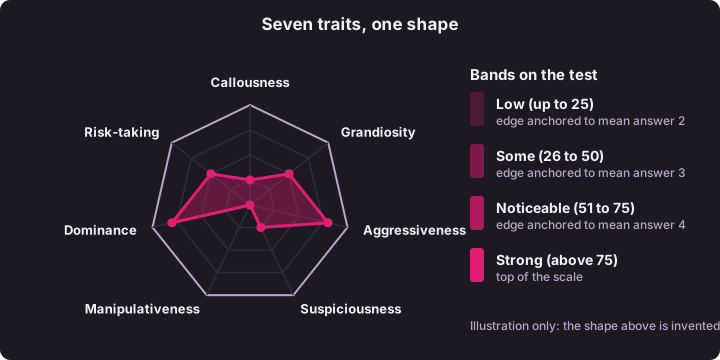
Two traits can sit high inside a perfectly moderate overall number, and the overall hides them. Take the worked example from the test. Sam answers the five aggressiveness statements 5, 4, 4 on the three keyed ones, and 2, 2 on the two reverse-worded ones. Reverse items are scored as 6 minus the answer, so the five scored values are 5, 4, 4, 4, 4. Their mean is 4.2, and (4.2 - 1) / 4 x 100 = 80, which is Strong. Dominance works out the same, also 80. Across all seven traits Sam's scores are 25, 50, 80, 25, 0, 80 and 50, which add up to 310, and 310 / 7 = 44.29. The overall reads 44, "Some".
| Band | Score | Mean answer at the edge |
|---|---|---|
| Low | up to 25 | 2 (Disagree) |
| Some | above 25, up to 50 | 3 (Neither) |
| Noticeable | above 50, up to 75 | 4 (Agree) |
| Strong | above 75 | up to 5 |
My advice for anyone with a profile like Sam's: ignore the average and work on the two high traits. In my experience aggressiveness and dominance travel together, because someone who needs to win a point tends to raise the temperature as well. That pairing is the one I see cause the most friction in meetings.
The bands come from the answer scale itself. 50 does not mean "the average person", because this test has no population norms. For what to do when you see one of these traits in someone else, read how to deal with a difficult person at work and at home. If you recognised yourself in a few paragraphs above, am I the difficult one is written for you.
Things people ask
What are the seven traits of a difficult person?
Callousness, grandiosity, aggressiveness, suspiciousness, manipulativeness, dominance (called domineering in the study) and risk-taking. They come from research on antagonism by Sleep, Crowe, Carter, Lynam and Miller.
Does one high trait make someone a difficult person?
No. A trait is a pattern of behaviour, and context matters: what causes trouble in one setting can be fine in another. Persistent difficulty across all settings is what deserves a closer look.
Is the difficult person test made by the researchers?
No. The test on this site uses 35 statements written for this site, mapped to the seven definitions. It is not the study's own questionnaire, it is not validated, and the researchers did not create or endorse it.
How is antagonism related to agreeableness?
Antagonism is the low end of agreeableness in the Big Five model. In the study it was linked with criminal behaviour, aggressiveness and substance use, based on a sample of 532 college participants.