When two people are stuck in the same recurring fight, I ask one quiet question: who has been in the room every time? If the honest answer is you, that is not a verdict. It is information, and it is the most useful thing a conflict can hand you.
Asking "am I the difficult one?" is already a good start, because it means you are willing to look. What follows is a kind, practical way to find out, using the difficult person test as one input among several, and a handful of small habits that make you easier to work and live with.
This is a self-reflection read, not a diagnosis or a psychological assessment. Nothing here labels a person; it describes behaviour you can observe.
Signs you may be the common factor
- The same friction shows up with different people in different settings: work, family, friends.
- People go quiet around you, or you notice they edit what they tell you.
- You win arguments but lose the cooperation that was supposed to follow.
- Your apologies tend to contain the word "but".
- You often feel surrounded by unfairness, incompetence or bad faith.
- Separate people have given you similar feedback, even if you thought each one was wrong.
One hard coworker is just one hard coworker. What matters is the pattern across settings. Joshua Miller of the University of Georgia, one of the antagonism researchers, put weight on context: behaviour that is a problem in one setting can be fine in another, and a flexible personality is a healthy one. So look for what travels with you everywhere, and be gentle about what shows up only in one place.
How to ask for feedback people will actually give
Most people will not tell you the truth unless you make it cheap for them. These steps work better than "be honest with me".
- Choose one person and one setting. Someone who sees you in meetings, say, and who has no reason to fear you.
- Ask a narrow question. "In meetings, what is one thing I do that makes me harder to work with?" Narrow questions get real answers; broad ones get politeness.
- Do not defend. Say "thank you, can you give me one example?" and stop there.
- Write it down afterwards, in their words, not yours.
- Come back after a few weeks and ask whether anything has changed. People notice the effort.
Using the comparison code
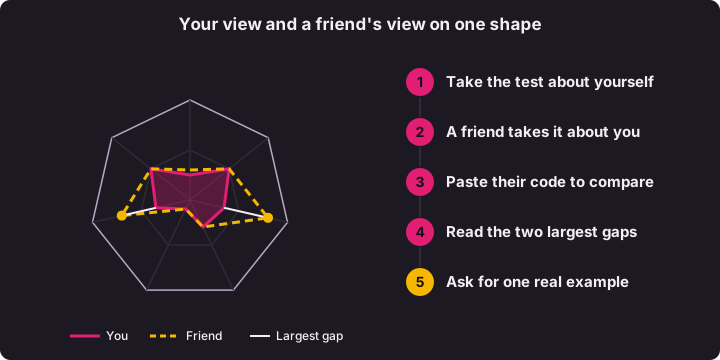
The test has a feature built for this. Take it about yourself, then ask a friend to take it in "about someone I know" mode, with the third-person wording, rating how you usually behave. Their result gives them a comparison code, a short string that starts with DPT1-O- followed by 35 digits. Paste it into the compare box and their view appears as a dashed amber shape over your magenta one, with a table of point differences and a line on the two largest gaps. Codes hold answers only, nothing goes in a web address, and nothing leaves your browser.
| What you see | What it might mean | What to do |
|---|---|---|
| They score a trait higher than you did | A blind spot, or a setting where you behave differently than you think | Ask for one example. Do not argue the number |
| They score a trait lower than you did | You may be harder on yourself, or you hold it back around them | Note it, and ask what they see instead |
| Both of you score it high | A pattern you both recognise | Pick it as your project for the next month |
| Both of you score it low | Nothing to chase. One snapshot, not proof | Leave it |
A friend sees you in some settings, not all, so ask two people if you can. And remember the limits: these 35 statements were written for this site, they are not validated, and there are no population norms. A score of 50 means your answers sat in the middle of the scale, nothing more.
Small habits that lower each trait
The reverse-worded statements in the test are, in effect, a list of habits. Pick one, run it for a week, and treat it as an experiment rather than a character reform.
| Trait | The experiment |
|---|---|
| Callousness | When someone shares a problem, ask one follow-up question before you offer a fix or change the subject. |
| Grandiosity | Once a day, say out loud what someone else did better than you would have. |
| Aggressiveness | Write the angry reply, delete it, send the calm one. When you are irritated, wait before you answer. |
| Suspiciousness | When you assume a motive, write down the plainest alternative explanation, then check one of them. |
| Manipulativeness | Ask for what you want in one direct sentence, and add "no is fine". |
| Dominance | Let people finish, count to two, then respond. Follow one plan this week without amending it. |
| Risk-taking | Before a big decision, say what could go wrong and who would pay. Sleep on it once. |
If feedback and your own result point at the same trait, start there. If they point at different ones, start with the one other people raised, because that is where the friction actually lands.
Context, flexibility and what a score cannot tell you
A result is a snapshot of how you answered seven groups of statements on one day, in one mood. The researchers did not create or endorse this test, and it is not a diagnosis. Being difficult describes behaviour in particular situations. A personality disorder is a clinical question that only a licensed professional can assess, and Miller's dividing line is persistent difficulty across all settings, not a rough patch in one of them. That is all I will say on diagnosis here, because it is the wrong question to start with. The better one is: what small change would make the next conversation go better?
When to talk to a counsellor
Consider a licensed counsellor or other mental-health professional when the same fights appear in every area of your life, when relationships keep ending the same way, when your anger frightens you or others, or when you take risks that hurt you or people around you. Asking for help is not an admission that something is wrong with you as a person. It is the same move as asking a friend for feedback, with better training on the other side of the table.
For a closer look at each trait, read the seven traits of a difficult person. If the difficult one turns out to be someone else, how to deal with a difficult person has the tactics.
Things people ask
How do I know if I am the difficult person?
Look for patterns that travel with you: the same friction in several settings, people holding back around you, or similar feedback from separate people. One hard relationship alone says little.
Can I become easier to get along with?
Small, specific habits help, such as pausing before replying when irritated or asking one follow-up question when someone shares a problem. Run one habit for a week at a time and ask a trusted person whether they notice a change.
Is the difficult person test accurate?
It is a self-reflection tool, not a diagnosis. Its 35 statements were written for this site, they are not validated, and there are no population norms, so treat a result as a conversation starter.
What is the difference between being difficult and having a personality disorder?
Being difficult describes behaviour in some situations, and context matters. A personality disorder is a clinical assessment that only a licensed professional can make, and it involves persistent difficulty across all settings.