
Your coworker reopens every decision you thought was settled, and by Thursday you are rehearsing arguments in the shower. Dealing with a difficult person is mostly a matter of choosing one behaviour, one sentence and one follow-up, not of winning.
Everything below works on behaviour you can see and describe. None of it needs a diagnosis of the other person, and I would advise against making one. A score from the difficult person test, even one you produced in rate-someone-else mode, is a way to organise your thinking. It is not evidence, and it is not something to wave in an argument.
This is a self-reflection read, not a diagnosis or a psychological assessment. Nothing here labels a person; it describes behaviour you can observe.
Three rules before any tactic
- It comes from them, not from your shortcomings. The Psychology Today summary of the antagonism research says this plainly for people living or working with an antagonistic person. You can improve how you respond. You did not cause the behaviour.
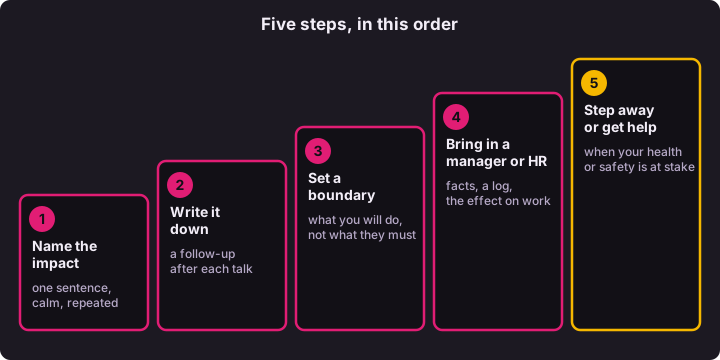
- Name the impact, calmly, and keep naming it. The same summary advises telling the person how their behaviour affects you, and doing so repeatedly. Same sentence, same tone, every time. Repetition without heat is what wears the pattern down.
- Describe the behaviour, never the person. "You interrupted me three times" can be agreed or checked. "You are rude" starts a trial.
The impact sentence
This is the single most useful tool I know, and it has three parts: what happened, what it did, and what you would like instead.
A worked version: "When you edit the shared slides after we have signed off, I end up presenting numbers I have not seen. Please message me before changing anything past sign-off." It has no adjectives about character and no guess about motive, which makes it hard to argue with.
What works for each trait, and what backfires
| Trait | What you see | What works | What backfires |
|---|---|---|---|
| Callousness | Your problem is treated as an interruption | Make requests practical and specific, tied to a result they care about. Get your emotional support elsewhere | Appealing to feelings alone, or waiting for a sign they care |
| Grandiosity | Credit-grabbing, rules that apply to others | Put names and contributions in writing early, so credit is settled before it is fought over | Public takedowns, or arguing about who is better |
| Aggressiveness | Harsh tone, sarcasm, anger | Stay level and quiet. Pause the talk: "I will come back to this in twenty minutes" | Matching the tone, or replying while angry |
| Suspiciousness | Ordinary events read as plots | Be predictable: say what you will do, then do it. Share information early and offer facts rather than reassurance | Surprises, side conversations, "you are being paranoid" |
| Manipulativeness | Flattery before asks, guilt, different stories to different people | Agree things in writing. Talk to people directly rather than through the go-between. Ask them to state the request in plain words | Accusing them of hidden motives, private side deals |
| Dominance | Takes over, reopens settled decisions | Agree decision rules in advance (who decides, by when). Give a real area to lead. Hold your position without turning it into a contest | Fighting for the last word, or giving in every time |
| Risk-taking | Impulsive bets, skipped steps | Steer toward safer outlets: a pilot, a sanctioned challenge, a checklist they co-own. Make consequences concrete | Lectures, or treating adventure itself as a flaw |
The risk-taker row follows the research summary, which suggests safer outlets. Most people I would call "bold" are not a problem once the boldness has somewhere useful to go.
At work: write it down, then escalate on facts
After any conversation that matters, send a short follow-up. It takes two minutes and it protects you from the manipulative, the grandiose and the forgetful alike.
- Thank them for the conversation, in one line.
- Restate what was agreed, in neutral wording: "To confirm: you will send the draft on Tuesday and I will review it by Thursday."
- Ask them to correct you if you got anything wrong. This keeps the tone cooperative and gets disagreement into the open early.
Involve a manager or HR when the pattern, not a single bad day, meets a few conditions:
- You have used the impact sentence at least twice and nothing changed.
- The behaviour affects the work, or other people, and not just your feelings.
- It is aimed at you or at a particular person or group.
- You keep a plain log of what happened, when, and who was present.
Go in with facts about effects. Leave out your theory about why they behave this way. Policies and processes differ between employers, so check what yours offers before you start.
At home: boundaries are about your own actions
You cannot make a relative or partner stop interrupting, but you can decide what you do when they do. A boundary names your action: "If voices get raised, I will leave the room and come back in half an hour." Then you do exactly that, calmly, every time. Inconsistency teaches people that your boundary is an opening bid.
Pick the moment too. Raise the hard topic at a calm time, not in the middle of a holiday meal or the minute someone gets home. For family gatherings, shorter visits and an agreed end time protect everyone, and so does not bringing up the topic that always blows up the evening.
If you use the test on someone else
Rate typical behaviour over months, not one terrible Tuesday. Treat the result as private notes. If a trait you did not expect lights up, that is a prompt to look for evidence, not a conclusion. Hold the traits against each person's context as well. A parent who is domineering at the dinner table may be easygoing everywhere else, and that flexibility is itself a good sign.
When to step away, and when to get help
Sometimes the right answer is distance: fewer meetings, a different team, a shorter visit, a longer gap between calls. That is a limit on what you will carry, not a judgement of the other person. Step away when the behaviour is persistent, when it affects your sleep or health, or when repeated clear requests change nothing.
If you are being threatened, controlled, followed or physically hurt, this guide is not enough. Contact your local emergency services or a local support line, and consider talking to a licensed mental-health professional about your own situation too. For understanding the traits themselves, see the seven traits of a difficult person. If you wonder whether some of the friction is partly yours, am I the difficult one covers that honestly.
Things people ask
How do you deal with a difficult person at work?
Describe one specific behaviour and its effect in a calm sentence, repeat it as needed, and confirm agreements in writing. If a pattern continues and affects work or other people, bring a plain log of facts to a manager or HR.
What should I do when a difficult person is a family member?
Set boundaries that describe your own action, such as leaving the room if voices rise, and keep to them every time. Choose calm moments for hard topics and use shorter visits when gatherings tend to go badly.
When should I involve HR or a manager?
When the behaviour is a repeated pattern, affects the work or other people, and has not changed after you named its impact at least twice. Bring dated facts and effects rather than theories about motives.
Can a difficult person change?
Behaviour can shift when its impact is named consistently and the surroundings give it somewhere safer to go. You cannot do their changing for them, so put your effort into what you control: your sentence, your follow-up and your boundary.